
Agency growth often breaks in the same place: content production. Clients want more SEO pages, more blog posts, faster turnarounds, and consistent quality—while your team juggles strategy, approvals, and reporting. White-label content solves this by letting you deliver content under your agency brand, with a process that’s repeatable and scalable.
Inkpilots positions itself as an AI-powered content automation platform for teams and agencies, built around “AI writing agents” that can generate, schedule, and publish SEO-optimized blog content with less manual work. ([inkpilots.com](https://www.inkpilots.com/en))
What “white-label content” means for modern agencies
White-label content is content you provide to clients as part of your service—without the client seeing the underlying production tool or vendor. In practice, that means:
- You own the client relationship and the deliverable standards.
- You define the voice, topics, and SEO goals.
- You deliver content in your workflow (docs, CMS, or exports), branded as your agency’s work.
- You keep margins predictable as volumes rise.
The best white-label setups don’t just “produce words.” They support consistent processes: briefs, editorial controls, collaboration, approvals, and reliable delivery.
Why agencies choose Inkpilots for white-label content operations
Inkpilots is designed around automation and scale—useful traits for agencies managing multiple clients, niches, and editorial calendars. Key capabilities highlighted by Inkpilots include AI agent-based content creation, built-in scheduling/publishing, team workspaces, a block editor, and export options. ([inkpilots.com](https://www.inkpilots.com/en))
1) AI writing agents that can run your content engine
Instead of generating one-off drafts, Inkpilots emphasizes AI “agents” that can continuously generate SEO-optimized posts. For an agency, that maps well to productized content packages (e.g., “8 posts/month + internal links + publishing”). ([inkpilots.com](https://www.inkpilots.com/en))
2) Built-in publishing and hosting (plus external publishing options)
Inkpilots notes that blogs can be published by default on Inkpilots’ infrastructure, and it also supports exporting/publishing content to external cloud providers. This matters for white-label delivery because some clients want “done-for-you publishing,” while others require content to be delivered into their own stack. ([inkpilots.com](https://www.inkpilots.com/en))
3) Collaboration features for multi-client delivery
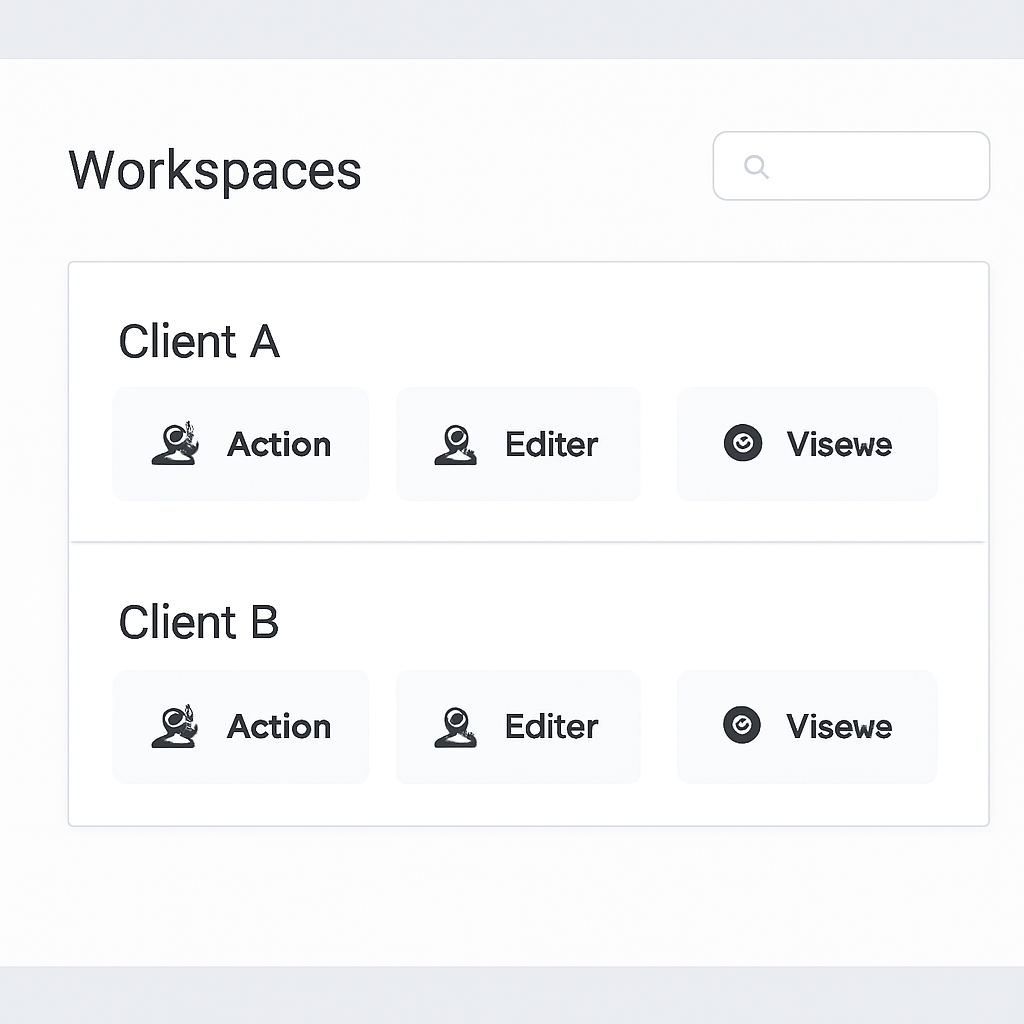
Agencies rarely operate as a single user. Inkpilots includes team workspaces with role-based access control and collaboration-oriented workflow features, which can help separate client work and manage internal permissions. ([inkpilots.com](https://www.inkpilots.com/en))
4) A block editor for fast QA and client-ready formatting
A structured block editor (Notion-style) can reduce the friction of turning a draft into a publishable post—especially when your team needs to add internal links, adjust headings, refine intros, and ensure every post matches your agency’s standards. Inkpilots lists a “Block Editor” as a core feature. ([inkpilots.com](https://www.inkpilots.com/en))

A practical white-label workflow agencies can run with Inkpilots
Here’s a client-friendly operating model that fits the features Inkpilots describes, while keeping your agency firmly in control of the outcome:
- Discovery & positioning: define client ICP, offers, and differentiation (your agency leads).
- SEO plan: map topic clusters, primary keywords, and content cadence.
- Agent setup: configure your AI writing agents to reflect the client’s services and topic focus. ([inkpilots.com](https://www.inkpilots.com/en))
- Editorial QA: your team edits for accuracy, tone, compliance, and on-page SEO using the editor workflow. ([inkpilots.com](https://www.inkpilots.com/en))
- Delivery: publish on Inkpilots-hosted blog or export/publish to the client’s environment. ([inkpilots.com](https://www.inkpilots.com/en))
- Reporting & iteration: review performance, refine topics, and update briefs.
How to keep white-label quality high (even at scale)
White-label content succeeds when clients see consistent results and consistent voice. To protect quality as output increases, agencies typically standardize these controls:
- Editorial checklist: brand voice, reading level, structure (H2/H3), internal links, meta elements.
- Content boundaries: what the client can/can’t claim, required disclaimers, regulated language rules.
- Human review points: define what must be reviewed by a strategist vs. an editor vs. a subject-matter reviewer.
- Publishing conventions: featured image rules, slug formats, categories/tags, and update cycles.
White-label delivery options: hosted, exported, or integrated
Agencies often need flexibility across clients. Inkpilots describes (1) default publishing on Inkpilots servers and (2) exporting/publishing to other cloud providers—useful when your portfolio ranges from early-stage startups to strict enterprise environments. ([inkpilots.com](https://www.inkpilots.com/en))
If you want deeper integration, Inkpilots also lists a Developer API and webhooks on its feature set (notably in higher tiers), which can support agency workflows that connect generation to QA systems, CMS pipelines, or client dashboards. ([inkpilots.com](https://www.inkpilots.com/en))
Security, privacy, and client trust considerations
White-label content delivery still requires trust—especially when client data, logins, and publishing environments are involved. Inkpilots’ privacy policy notes it does not sell personal information and may share information with service providers to operate the service. ([inkpilots.com](https://www.inkpilots.com/privacy))
For agency use, the practical takeaway is to keep your own internal SOPs tight (who can access what, how drafts are reviewed, and what client-sensitive information is ever placed into prompts). When needed, align your process with the client’s compliance requirements.
Who Inkpilots white-label content fits best
Inkpilots’ positioning—AI agents, team workspaces, publishing, exports, and automation—tends to align well with agencies that:
- Sell ongoing SEO content retainers (monthly volume matters).
- Want a repeatable, productized production workflow.
- Manage multiple clients and need permissioned workspaces.
- Need both “publish for me” and “export to our stack” delivery options. ([inkpilots.com](https://www.inkpilots.com/en))
Getting started: a simple rollout plan for agencies
To implement white-label content without disrupting current accounts, roll out in phases:
- Pilot one client: pick a stable niche and a predictable posting cadence.
- Create a template: editorial checklist + brief format + QA workflow.
- Scale to a small pod: 3–5 clients with similar content needs.
- Standardize reporting: publish cadence, indexation checks, and basic performance snapshots.
- Expand: add more clients once revision cycles and QA time are predictable.
Conclusion
White-label content is ultimately an operations advantage: you deliver more value per hour while keeping quality consistent. Inkpilots’ agent-based generation, collaboration workspaces, editing workflow, and flexible publishing/export options are built around the agency reality of “many clients, many deadlines.” ([inkpilots.com](https://www.inkpilots.com/en))