
Scaling a team is rarely limited by hiring alone. The real bottlenecks tend to show up in clarity (who owns what), consistency (how work gets done), and capacity (how fast you can deliver without quality slipping). Inkpilots’ partner model is designed to address those constraints by pairing specialized, accountable partners with a client’s internal team—so growth is structured, repeatable, and less dependent on heroic effort.
This article breaks down how a partner-led approach can help organizations scale delivery, maintain standards, and create momentum—especially when priorities shift and timelines get tight.
What “Scaling Teams” Actually Means (Beyond Hiring)
Scaling isn’t just adding people. A team is “scaled” when it can reliably produce outcomes at a higher volume or higher complexity—without increasing risk, rework, or leadership overhead at the same rate.
- More throughput without sacrificing quality
- Clear ownership and fewer handoff gaps
- Faster onboarding and less tribal knowledge
- Standardized delivery routines that don’t depend on a few individuals
- Predictable planning and reporting as work increases
A partner model is most valuable when growth pressure exposes weak points in process, prioritization, and accountability—not just headcount.
What Is the Inkpilots Partner Model (Conceptually)?
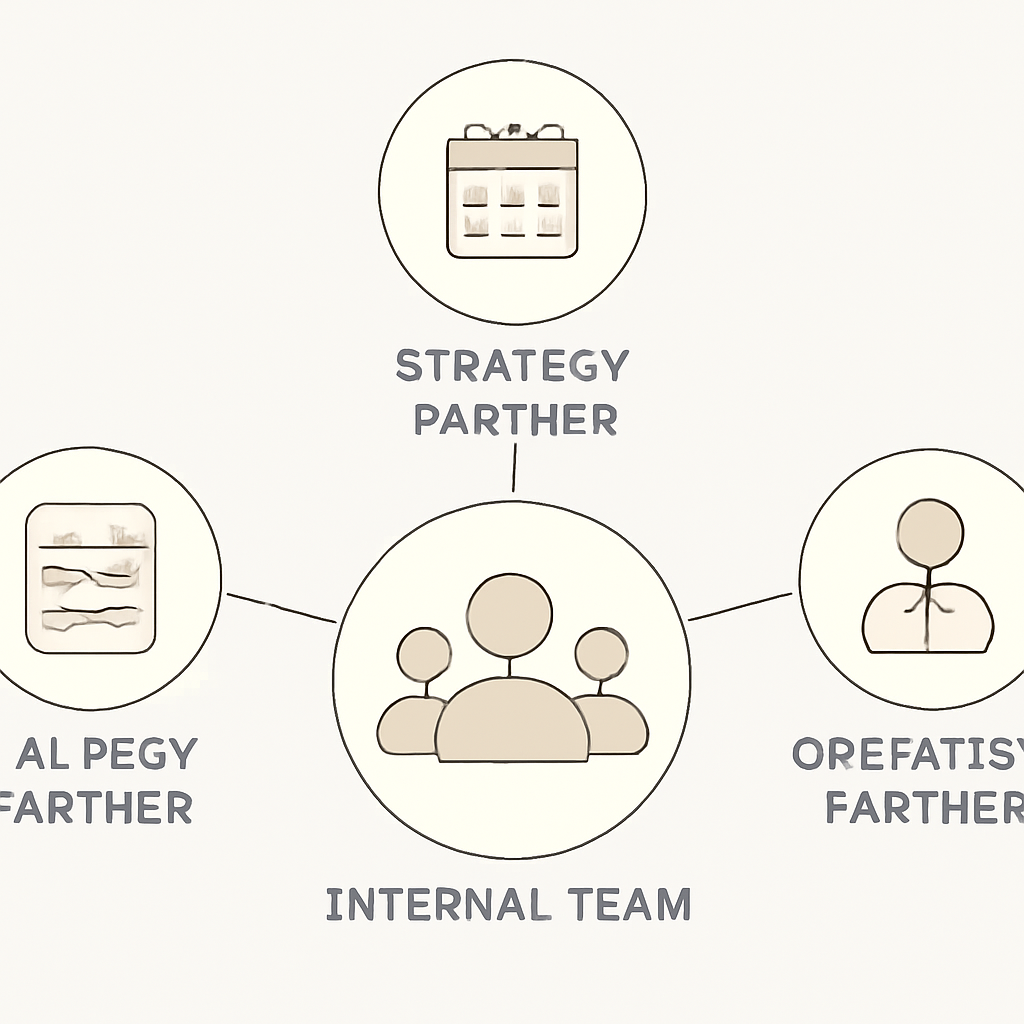
At a high level, Inkpilots’ partner model is an operating approach where partners act as embedded, accountable leaders or specialists aligned to specific outcomes. Instead of simply “adding capacity,” the partner relationship is structured around ownership, delivery standards, and repeatable ways of working—so the team can scale with consistency.
Think of it as a blend of strategic partnership and execution support: partners don’t just advise—they help run a system that produces results, then strengthen that system over time.
Core Principles That Make a Partner Model Scalable
A partner model only works if it reduces complexity rather than adding another layer. These principles are typically what separates scalable partnership from “extra meetings.”
- Outcome ownership: each partner area is accountable for measurable results, not just activity
- Clear interfaces: defined handoffs, decision rights, and escalation paths
- Standard rituals: consistent planning, review, and retrospectives to prevent drift
- Documentation by default: decisions, processes, and definitions live in shared systems
- Capability lift: partners help internal teams level up so performance improves over time
If any of these are missing, growth tends to create noise: more stakeholders, more ambiguity, and slower cycles.
How the Partner Model Helps You Scale Without Burning Out Leaders
Many organizations discover that leadership bandwidth—not hiring—is the limiting factor. When everything routes through a small set of leaders, scaling becomes fragile.
A partner model can reduce leadership load by creating additional accountable “owners” who can:
- Run execution cadences (planning, prioritization, delivery reviews)
- Translate strategy into actionable workstreams
- Spot risks early and resolve them before they cascade
- Create repeatable playbooks that new hires can follow
- Keep quality standards consistent as volume increases
The aim isn’t to replace internal leadership—it’s to make leadership leverage higher and the system more resilient.
A Typical Operating Rhythm (What It Looks Like in Practice)
While every team’s cadence differs, a scalable partner model usually depends on a few repeatable routines. The key is that these routines produce decisions, not just updates.
- Weekly prioritization: align what matters most and cut low-value work
- Delivery check-ins: validate scope, progress, blockers, and next steps
- Quality review: ensure standards are being met (definitions of done, acceptance criteria)
- Monthly planning: recalibrate goals, capacity, and sequencing
- Retrospectives: improve the system, not just the output
If you’re scaling, the question to ask is: “Do our meetings reduce uncertainty and improve delivery, or are they just status loops?”
Where the Partner Model Fits Best (And Where It Doesn’t)
A partner model is not a universal solution. It’s most effective in environments with real delivery pressure and a need for repeatable execution.
Strong fit
- Teams growing quickly and struggling with coordination
- Organizations that need consistent quality across more workstreams
- Leaders stretched thin by planning, hiring, and delivery oversight
- Projects that require cross-functional alignment (product, marketing, ops, engineering)
- Companies that want a scalable operating system, not just temporary help
Potential mismatch
- Very small efforts where informal communication works fine
- Teams that can’t define outcomes or won’t commit to ownership
- Situations where partnership is treated as “extra hands” with no authority to improve the system
How to Implement a Partner Model: A Simple Start Plan
If you’re considering a partner model to scale, start small and operational—then expand.
- Define the outcomes: pick 1–3 outcomes that matter (speed, quality, predictability, or capacity)
- Assign ownership: clarify what the partner owns vs. what internal leaders own
- Set the cadence: establish weekly and monthly routines that produce decisions
- Create a shared workspace: documentation, decision logs, and definitions live in one place
- Measure and adjust: review what improved, what didn’t, and iterate
The biggest early win is usually reducing ambiguity: fewer unclear handoffs, fewer re-decisions, and faster execution loops.

Common Pitfalls (And How to Avoid Them)
- Pitfall: Treating partners like contractors with no decision rights. Fix: define authority boundaries and escalation paths.
- Pitfall: Adding ceremonies without outcomes. Fix: every ritual must produce a decision or an improvement item.
- Pitfall: No single source of truth. Fix: centralize documentation and decision logs.
- Pitfall: Scaling work faster than quality controls. Fix: establish clear acceptance criteria and quality reviews.
- Pitfall: Assuming the model will “work itself.” Fix: revisit ownership and metrics monthly.
Conclusion: Scaling Is a System—The Partner Model Helps You Build It
Inkpilots’ partner model (as a concept) focuses on making scale sustainable: clear ownership, consistent delivery routines, and a system that improves as it grows. If your organization is adding people but still feels slower, noisier, or less predictable, that’s often a sign the operating system needs to scale—not just the headcount.
A well-designed partner model can bring structure without rigidity, speed without chaos, and growth without burning out the people responsible for making it all work.