


Hello there. This is Tolga from Inkpilots, and I have something to say about embedded signals in AI-generated text.
What Is Claude Watermark?
Claude Watermark is an algorithm for detecting AI-assisted or AI-generated content. AI models simply try to guess the next word based on the context you create. Claude and most model providers then add a deterministic method to create a pattern in the generated text. The pattern is not hidden text but more like a statistical method used while generating the words.
The pattern involves forcing the model to create the next word with a mathematical probability, which we can detect once we convert the text to numerical data because it follows a deterministic pattern. Some people address the issue by saying that tampering with model generation may reduce the quality of the generated content, but Claude claims that this is not the case. This statistical signal is embedded in your AI-generated text most of the time, and even slight modifications may not remove it.
Does Claude Watermark Damage Your Visibility?
I think so. This is my personal opinion, but it affects visibility, and I have some data to show you. You should know that Google and most model providers have been embedding similar patterns in their generated text for a while, so there is actually nothing new here. The main reason—my personal opinion again—is that Anthropic has been spending more on marketing than any other company. They are not doing anything particularly innovative, but they spend on marketing to make a fuss about it. I understand that strategy. It is pretty common.
What Is the Purpose of Claude Watermark?
The main purpose is to detect spam content so that search engines can favor original, human-reviewed information. E-E-A-T is about being original and offering information that the system does not already have. For further information, you may check Google's spam policies.
What Can We Do to Protect Our Content?
- Instead of generating spam, create templates and fill them out yourself.
- Always review generated text and improve it with your editorial skills.
- Do not ask AI to write. Instead, write first, then let AI review it and offer you some improvements.
For more detailed information, check our article about content spamming and its effect on your branding.
Common Misconceptions
- Using AI does not guarantee that your content will rank lower.
- Not using AI does not guarantee that your content will rank higher.
Data from Our Inkpilots Blog Page
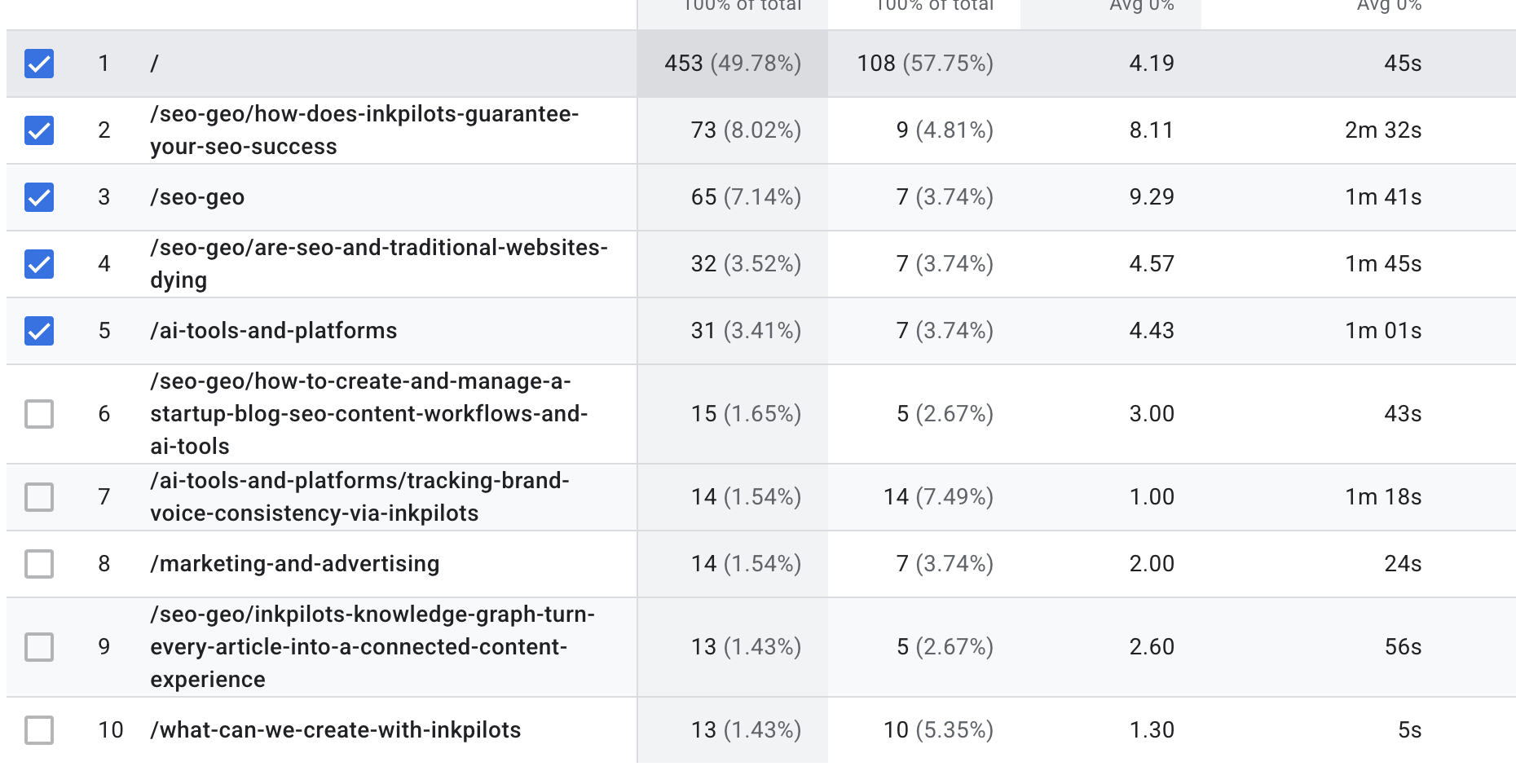
Our Google Analytics data shows that almost every AI-generated page in the blog application is getting zero visibility. On the other hand, our top-listed articles are mostly those written by me and reviewed to serve a purpose. Below is an image showing our data. As you go down the pages, you start to see test content generated mostly by OpenAI models.
Similar Provenance Signals from Google and OpenAI
Google has been using something called SynthID for a while, and it is open to people who want to detect AI breadcrumbs in text. It has a similar structure, and Claude's Watermark is, in a way, a successor to SynthID. However, SynthID is a group of technologies supplied by Google DeepMind, and it is multimodal: it supports text, image, video, and audio detection. On the other hand, Claude Watermark is product-based and is used inside Claude to add the watermark pattern to generated text. For more detailed information, please refer to the Claude News and Google DeepMind SynthID websites.
How to Use Inkpilots Without Publishing AI Slop?
Since the beginning of the platform, I have been able to see these changes in the industry and reroute the application's course toward a different, more human-in-the-loop method. Assuming that AI writes the content is a worldview that is no longer worth embracing. A tree does its job without expecting anything, but we are not trees; we have intellectual skills that allow us to create over time. So, I decided to build the application and its AI features around users to make it easier to be creative.
In more technical terms, I support a simple prompt to start writing an article. I ask AI to research and generate an outline for me: What should I write about in each section? Then I start building on top of that. Below is the prompt block I used to launch the current draft:
Write a template for the topic: "Does Claude's Watermark Affect Your SEO?"
Structure:
- Introduction with an explanation and answer
- Similar watermark usage by AI model providers
- Data from the InkPilot blog page, inkpilot.app, to show AI punishment
- How to improve quality with InkPilot without facing AI slop penalties
- Conclusion
Write a title and add a paragraph explaining what to discuss. Conduct online research to add relevant evidence. Add candidate internal links. Do not write the content; instead, explain what to write in each paragraph.
Once I am ready to publish, I write a prompt to fix the grammar and typos.
With Inkpilots, creating content-driven websites is much faster and easier than it has ever been. I want our users to focus on creating content instead of dealing with chores and technical difficulties. For further information, check out our application and create your website with Inkpilots.
Conclusion: Content Value Is the Real Deal
No matter what, AI spam will damage your branding. I have seen content go to garbage more than once. Instead of creating spam, start with baby steps to create your website, then scale as you grow. We provide many features to help you, and your work is valuable to the system itself. Do not forget: a watermark is not a direct ranking penalty, but unedited spam surely might be. The data we have reflects this. There are different subdomains inside our application that get zero visibility due to AI spam.
This is all for now.
Sincerely,
Tolga